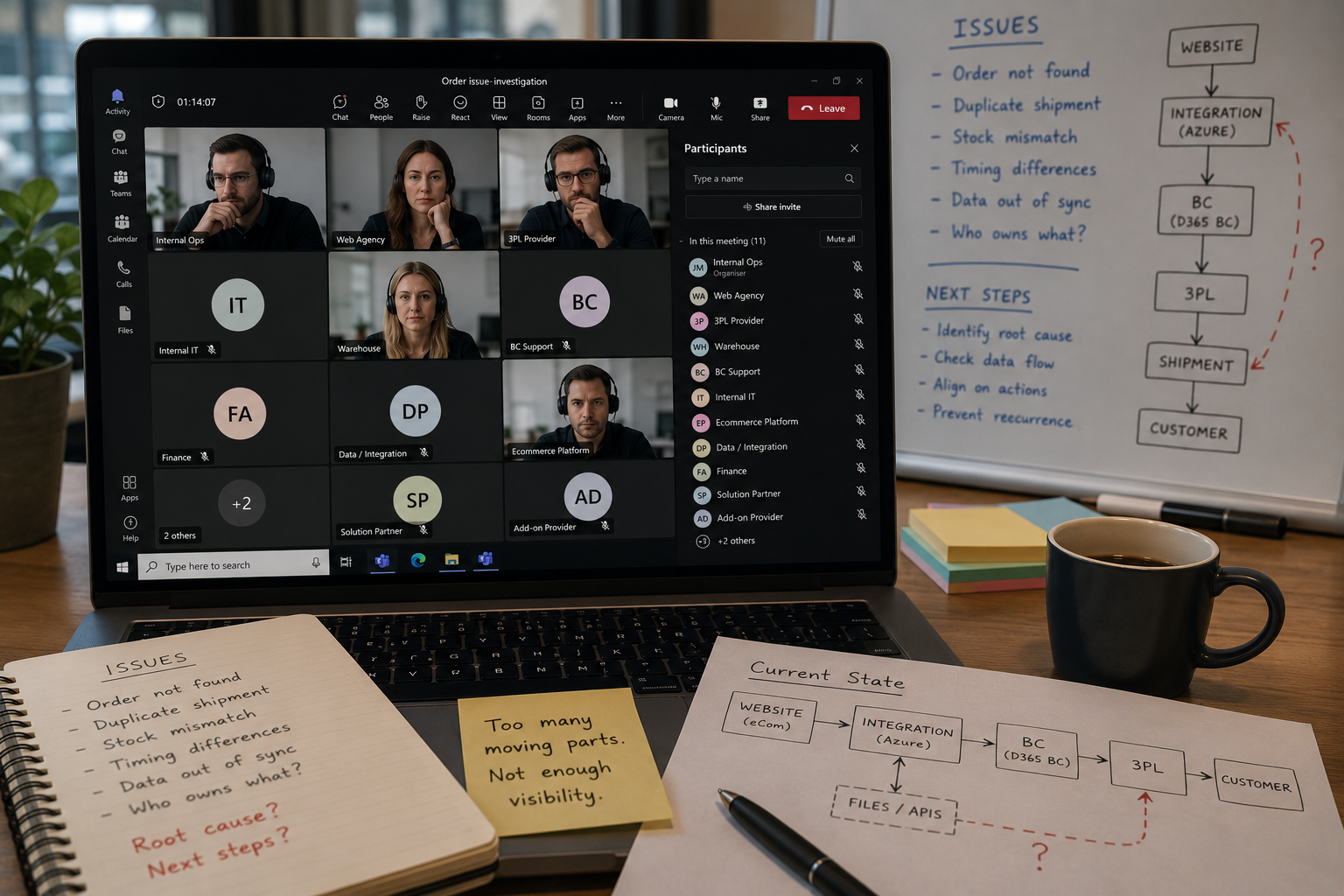


Businesses rarely stop trusting their ERP systems all at once.
Usually it happens one workaround at a time.
A product setup process begins outside the ERP system because the business needs to move quickly. Pricing structures evolve separately from operational governance. Customers send orders through EDI, but still email copies “just in case”. Finance introduces additional validation because operations and reporting no longer feels completely reliable.
Eventually, the business adapts around the system instead of through it.
By that stage, the problem is rarely a single bug or failed implementation.
More often, the organisation has gradually stopped trusting its own operational processes and systems to consistently reflect operational reality.
And that usually happens far more slowly, and quietly than most businesses realise.
“Eventually, the workaround stops feeling temporary and simply becomes how the business works.”
Operational Workarounds Rarely Stay Temporary
Most ERP environments do not become fragile overnight.
The drift usually begins with operational pressure.
A department needs a quick fix. A customer requires a process variation. A sales team wants to secure an urgent order. Warehouse operations need stock moving immediately. A workaround gets introduced to keep things flowing. A customisation solves one immediate issue without enough consideration for wider operational impact.
None of these decisions are necessarily unreasonable in isolation.
The problem is that businesses often underestimate how quickly temporary operational compromises become permanent parts of the architecture.
A manual validation step introduced during a busy trading period survives for years because nobody feels safe removing it.
An operational process originally managed outside ERP governance quietly becomes embedded into day-to-day operations.
An exception process designed for urgency slowly becomes the standard approach.
Businesses rarely lose trust in ERP systems all at once.
Usually they lose it one operational compromise at a time.
The Symptoms Often Appear Somewhere Else Entirely
One of the more misleading aspects of ERP issues is that the visible pain rarely originates where the real problem started.
Finance teams often experience the consequences last.
Month end delays, reconciliation work and reporting inconsistencies are frequently downstream symptoms of operational failures introduced much earlier in the process chain.
We have seen situations where:
- ecommerce platforms showed stock as available that did not physically exist
- stock was physically available but could not actually be sold
- warehouse delays prevented fulfilment updates posting correctly into ERP
- pricing logic drifted between operational processes and core systems
- operational teams introduced additional validation because confidence in automation had weakened
By the time finance is manually correcting figures at month end, the original issue may have started weeks earlier inside product onboarding, warehousing, integrations or fulfilment workflows.
This is one of the reasons heavily technical fixes often fail to solve the wider problem.
The issue is not always software capability.
Often, it is that the operational process itself has become fragmented across too many disconnected workflows, exceptions and owners.
ERP Systems Quietly Stop Reflecting Operational Reality
One recurring pattern we see is operational processes gradually evolving outside the ERP platform entirely.
Products may begin life in disconnected approval workflows, spreadsheets or email chains because commercial urgency overrides governance. Planning activities evolve externally because trust in core operational processes has already weakened. Critical operational knowledge becomes embedded in individuals rather than systems.
If the ERP system does not reflect how the business actually operates, people will create parallel processes that do.
Over time, the ERP platform stops being the operational source of truth and instead becomes one participant in a wider collection of disconnected processes.
That creates predictable problems:
- duplicate data
- inconsistent identifiers
- fragmented ownership
- unreliable reporting
- increasing manual intervention
- and growing operational caution around automation
Even relatively small governance gaps can create disproportionately large operational consequences later.
One particularly common example is products being sold or processed before item governance has been completed properly.
Under commercial pressure, businesses often prioritise speed over operational consistency.
A sales team wants to secure the order. Stock needs receipted urgently. Operations need goods moving immediately.
So the item gets created quickly, but key governance steps are skipped.
Later, the consequences appear somewhere else entirely.
Batch tracking may be missing where traceability was required. Retail compliance issues emerge. Transactions become difficult to correct safely. Teams are forced into uncomfortable operational decisions:
do we stop operations and fix the issue properly now, or continue processing orders and untangle the problem later?
At that stage, the organisation is no longer dealing with a simple setup issue.
It is dealing with operational risk introduced through process inconsistency.
The dangerous part is that businesses often adapt to these conditions gradually.
People stop expecting the system to behave consistently and instead build additional checks around it.
EDI Problems Are Often Not Really EDI Problems
EDI environments expose this pattern particularly clearly.
Businesses often assume EDI failures are communication problems between platforms.
In reality, many recurring “EDI issues” are actually process, ownership or data quality issues elsewhere in the organisation.
For example:
- products identified differently across systems
- inconsistent units of measure
- duplicate barcodes
- pricing discrepancies
- incomplete operational ownership
- manual handling introduced around unreliable workflows
One of the clearest warning signs is when businesses continue operating legacy manual processes alongside EDI because trust in automation never fully develops.
Orders arrive electronically, but customers still send email copies “just in case”.
Operational teams manually validate transactions that should already be governed by the process itself.
At that point, EDI risks becoming little more than an electronic order delivery mechanism rather than delivering the operational efficiency it was intended to provide.
The issue is rarely the existence of EDI itself.
More often, the organisation has not aligned operational process ownership, governance and system design closely enough for automation to become genuinely trusted.
Complexity Is Not the Same as Capability
One uncomfortable truth in ERP projects is that complexity is sometimes mistaken for sophistication.
Some environments become so operationally fragile that businesses mistake the effort required to operate them for sophistication.
In reality, highly customised ERP environments are not always more capable.
Very often, they are simply harder to:
- understand
- support
- troubleshoot
- scale
- and safely change
Customisation absolutely has a place. Some operational requirements genuinely justify bespoke workflows or integrations.
But healthy ERP environments tend to share one important characteristic:
they remain understandable over time.
That usually means:
- supported platforms where practical
- clear operational ownership
- transparent workflows
- governed master data
- maintainable integrations
- and reducing hidden dependencies wherever possible
In some cases, the right answer is not introducing another custom layer.
It is simplifying the operational process itself.
Trust Matters More Than Perfection
No operational ERP environment is ever completely clean.
Processes evolve. Exceptions happen. Businesses change faster than systems sometimes can.
The goal is not perfection.
The goal is maintaining enough trust in operational systems that the business can continue scaling without compensating through manual validation, duplicated effort and institutional workaround knowledge.
Because once organisations stop trusting their ERP data, they usually start building parallel processes around it:
- spreadsheets
- duplicate approvals
- shadow reporting
- manual checks
- exception workflows
- and increasing dependence on specific individuals
Those workarounds may keep the business operational in the short term.
But the operational cost accumulates quietly:
- slower decisions
- reduced automation confidence
- duplicated effort
- increased onboarding complexity
- and growing dependence on institutional knowledge
Eventually, the business is no longer scaling through its systems.
It is compensating for them.
Many organisations are now exploring AI initiatives while still struggling with fragmented ownership, inconsistent master data and low trust in core operational processes.
In practice, AI tends to amplify the operational environment around it – good or bad.
Businesses still compensating for unreliable core processes are rarely in a strong position to benefit meaningfully from additional automation or intelligence.
The healthiest ERP environments are rarely the ones with the most technology or the most customisation layered around them.
They are usually the ones where:
- operational ownership is clear
- systems continue reflecting operational reality
- processes remain understandable
- and the business continues improving intentionally over time
Continuous improvement matters because operational drift happens gradually.
What feels like a small operational compromise today can quietly become a major constraint later as the business scales.
The organisations that get the most value from ERP are usually not the ones chasing perfection.
They are the ones willing to continually improve how systems, processes and operational reality align over time.